
Slooh in the Dome: How Casper Planetarium Enhances Every Show

.png)
How Casper Planetarium uses Slooh to extend the dome experience for planetariums and science centers everywhere


Overview
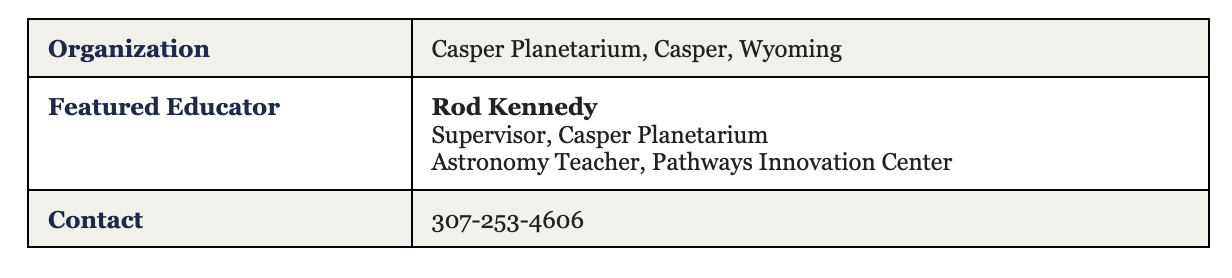
Casper Planetarium is Wyoming's oldest planetarium, in continuous operation since 1966. It operates as part of the Natrona County School District, running a full slate of public and school shows out of a dome in Casper, Wyoming, using digital projection technology from Digitalis Education Solutions. Under Supervisor Rod Kennedy, who also teaches astronomy and ninth grade physical science at Pathways Innovation Center, the planetarium has become one of the more inventive users of Slooh imagery outside a traditional classroom, building it directly into live dome shows and using it to solve a problem that has nothing to do with equipment and everything to do with weather.
Source: Casper Planetarium, Natrona County School District, sites.google.com/myncsd.org/casperplanetarium
The planetarium runs shows five days a week.
“We're a school district planetarium, so we have school groups all the time. We do shows five days a week, Tuesday through Friday, with an afternoon show, plus the first three Saturdays of each month.”
— Rod Kennedy, Supervisor, Casper Planetarium
The Challenge: Clear Skies Are Not Enough
Wyoming's skies are comparatively dark, but dark skies do not solve the practical problem of getting students outside to use a telescope. Casper's winters make hands-on observation nearly impossible for large parts of the school year, and even on a clear night, students still need to learn the mechanics of finding and tracking an object before they ever see anything worth looking at.
“The reason I use Slooh in my classroom is, have you ever been in Wyoming in the wintertime? It is not conducive to being outside. The nights when it is clear, it's frigidly cold, and the nights that it's not frigidly cold, the wind is howling.”
— Rod Kennedy
The logistics extend beyond weather. Kennedy pointed out that observational astronomy asks a lot of students before they get any payoff at all.
“You have to teach the students not only what to look for, but how to run the telescope. There are all these layers of stuff they have to know how to do. With Slooh, if you want to see the objects, this is the way to do it. It makes it a lot more accessible.”
— Rod Kennedy
The Solution: Slooh Imagery, Live on the Dome
Rather than treating Slooh as a separate, screen-bound activity, Kennedy built it into the planetarium's live shows. Using the dome's Nightshade projection software from Digitalis Education Solutions, he created guided tours built around individual constellations rather than a full sweep of the night sky, then used Slooh imagery as the payoff at the center of each stop.
“This is a tour of how we would do this on our planetarium dome. We use the system from Digitarium called Nightshade. I wanted to create guided tours for specific constellations instead of an entire tour of the night sky.”
— Rod Kennedy
As the tour reaches an object such as M8, M22, or the Trifid Nebula, Kennedy zooms in on the projected star field and drops in a Slooh image captured at the object's actual sky coordinates, rather than simply displaying the image on its own.
“This is my Slooh image. It's actually at the coordinates where the object is, and I zoom up the image. To me, it's a little more interesting if you bring it up at the exact coordinates where the object is.”
— Rod Kennedy
The effect ties a real image, captured through an actual telescope, to the exact patch of dome sky the audience is already looking at, giving school groups and public audiences a concrete sense of what a telescope in Slooh's network actually sees.
From the Dome to the Classroom
Kennedy's use of Slooh does not stop at the planetarium. He also brings it into his astronomy course and his ninth grade physical science class, where it covers a short astronomy unit within a broader science curriculum.
“I also use this with my ninth grade physical science class, because they have a short unit on astronomy.”
— Rod Kennedy
The planetarium tours themselves double as a bridge back to the classroom and to families. A student who sees a constellation and its objects on the dome can go home, log into Slooh, and revisit the same coordinates on their own, turning a one-time show into something they can return to. Kennedy also singled out a few Slooh Quests as consistent favorites in his own courses.
“There are several quests I really like using. The stellar evolution ones are great, and the galaxy one is pretty cool.”
— Rod Kennedy
Why It Matters for Other Planetariums
Casper Planetarium's model, pairing a live dome tour with Slooh imagery tied to real coordinates, is also shaping Slooh's broader plans to formalize partnerships with planetariums and science centers, offering an account tier that visiting school groups and families can take home after a show.
Casper Planetarium's approach offers a template that any dome operator can adapt, regardless of climate or region: build Slooh imagery into the show itself, anchor it to real coordinates rather than static pictures, and use it as a bridge that sends visitors home with a way to keep exploring.
For planetariums weighing whether a platform like Slooh belongs inside the dome or only outside it, Kennedy's experience suggests the two are not in competition.
“It's like, if you want to see the objects, this is the way to do that.”
— Rod Kennedy