Slooh Pro For Researchers

Publication-Ready Data. No Proposal Required.

Research-grade telescopes across three continents, with spectroscopy, photometry, and astrometry capabilities. $499/year — less than an hour at most observatories.

See Purchase Options
Princeton University
Yale
Institute of Astrophysics of the Canary Islands
Purdue University
Catholic University
YOUR INSTRUMENTS

Nine Telescopes. Three Continents. Your Coordinates.

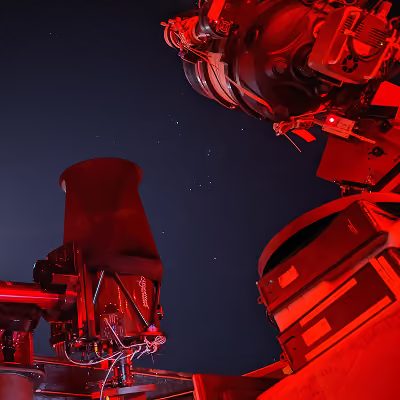
No more waiting for clear skies in your backyard. Control telescopes at 9,000 feet in the Canary Islands, the Chilean Andes, and outback Australia — and point them wherever you want using RA/Dec coordinates.
Science on Slooh

Research-Grade Capabilities

Slooh capabilities listed here have been used in published research or accepted data submissions.
telescope
See The Whole Sky
RA/Dec Coordinate Control
Go beyond the catalog. Enter custom coordinates to observe any target, including newly discovered objects.
Access All Settings
All Catalogs & Processing Presets
Full access to every catalog and processing preset. Photometry, astrometry, spectroscopy and deep imaging ready out of the box.
More Telescope Time
1 Advanced Mission at a Time
Choose telescope, date, time, target. Plus 5 standard missions running simultaneously.
FAQs
What's the difference between Explorer and Advanced and Pro?

Explorer gives you live feeds, guided Quests, and standard mission scheduling. Advanced adds RA/Dec coordinate control, all catalogs and processing presets, Advanced Mission scheduling (choose telescope, date, time, target), FITS data, spectroscopy, and Advanced mission Quests. Pro gives you access to 5 Advanced missions at a time, instead of 1 with Advanced allowing for extended observations.

 What data formats do I get back from a mission with a Pro plan?

Every mission delivers calibrated FITS files plus processed PNGs. FITS headers include exposure time, filter, coordinates, and telescope ID — supporting photometry, astrometry, spectroscopy, and astrophotography post-processing.

Can I publish with Slooh data, and how do I cite it?

Yes. Slooh data has appeared in peer-reviewed papers and accepted submissions to the Minor Planet Center. Every Pro mission returns calibrated FITS with full metadata, so your measurements are reproducible and reviewable. We provide observatory codes and acknowledgment language for your methods section.

SLOOH IN RESEARCH

Using Slooh For Interstellar Object Research

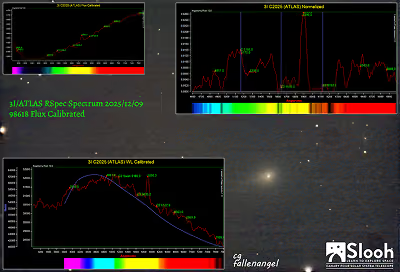
3I/ATLAS is only the third interstellar object ever recorded crossing our solar system — and Slooh's robotic network captured its spectrum while professional teams were still publishing their first results. Using the CAT4 telescope and an RSpec workflow, members resolved the daughter-molecule emission bands that define the comet's coma chemistry — the same features optical campaigns used to derive its production rates. Slooh gives independent researchers, students, and citizen scientists real spectroscopic access to frontier targets, on demand, without an observing proposal or a telescope of their own.
MEMBER RESEARCH
A Member-Processed Spectrum of Interstellar Comet 3I/ATLAS
Slooh member CGFALLENANGEL processed this CAT4 spectrum of 3I/ATLAS, captured December 9, 2025, using RSpec. The reduced spectrum shows a steeply rising red continuum — the mark of a dust-rich coma — overlaid with the emission bands of the comet's carbon chemistry: the CN violet band near 3883 Å, the C₃ group near 4050 Å, the C₂ Swan sequences through the green, and a sharp [O I] line at 6300 Å. Every feature is consistent with the daughter-molecule detections professional optical campaigns reported for 3I/ATLAS over the same period. The full band-by-band reduction is in the comments.
Avatar
Captured by cgfallenangel on Slooh Canary Four Solar System
PLANETARY SCIENCE

From Earth’s Surface to the Edge of the Solar System

Advanced access pairs Slooh’s satellite feeds with full solar and planetary monitoring. Observe Earth from orbit, track sunspots and prominences in H-alpha, and follow the planets through their seasons — all with the same instruments and data formats as your deep-sky work.
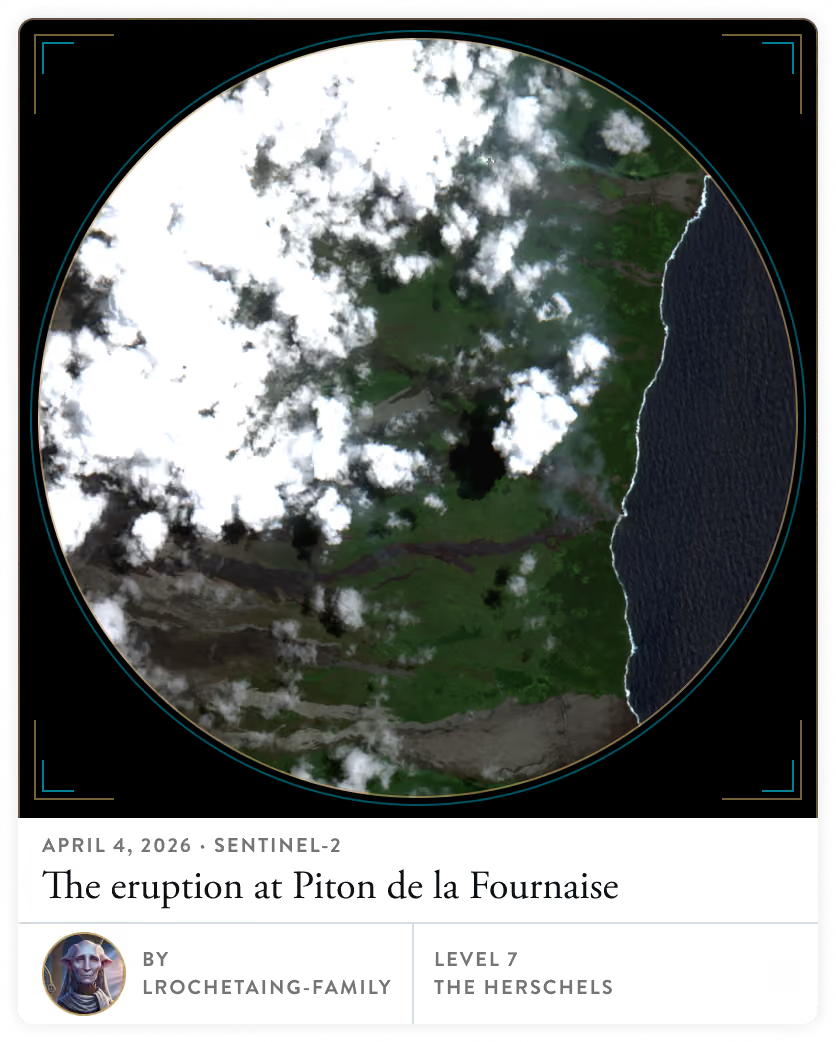
Observation of the eruption at Piton de la Fournaise
Solar Monitoring in H-alpha
Track active regions, prominences, and filaments on the Sun’s surface — the only star close enough to watch change from one day to the next.
Planetary Imaging
Image the disks of Jupiter, Saturn, Mars, and Venus. Follow the Great Red Spot and Saturn’s ring tilt across an observing campaign.
Earth Observation from Orbit
Slooh’s satellite feeds put real remote-sensing data in your hands — geology, weather systems, and surface change, studied with the same rigor you bring to the night sky.
THE COMMUNITY

 Serious Observers, Generous People

The Slooh community includes everyone from first-time hobbyists to published researchers. As a Pro member, your observations don't just fill your own collection — they show up in the community feed, inspire newer members to try something harder, and raise the bar for what's possible with these telescopes.
Be on Target When It Counts
Occultations, outbursts, a comet at peak, a nova alert — when the sky does something that won't wait, we gather and point fast, so you're observing the moment instead of missing it to weather or geography.
A Room Full of Real Observers
Trade technique with people who know the details. Slooh Star Parties draw committed observers from 55+ countries.
Walk Away With the Data
Anything you capture during a Star Party lands in your gallery as downloadable data — ready for processing, a personal project, or to share with the world.
Testimonials

Hear From Researchers on Slooh

Researchers around the world are using Slooh to explore the night sky without being constrained by budgets, travel, or institutional access to telescopes.

“The Slooh observations are extremely important since they provide information on both the brightness of the SN and the color shortly after discovery."

Emmanuel Conseil — Supernova Researcher

Slooh has completely transformed my astronomy journey. The professional-grade telescopes, dark-sky access, and supportive community helped me grow my astronomy and astrophotography skills far beyond what I thought possible. Slooh isn't just a telescope platform, it's a community.”

Shawn Hutchinson, Slooh Member since 2016 & Slooh Ambassador since 2021

“I joined Slooh in 2017 while coordinating STEM activities in a Connecticut library makerspace. When Slooh introduced its solar telescope, I discovered a passion for observing our closest star and developed a deep interest in space weather and astronomy. Along the way, I've been inspired by Slooh's global community, whose encouragement, knowledge, and friendship have made the experience even more rewarding.”

Jenny McLachlan, Slooh Member since 2017
400K+
Members to date
13.8M+
images captured
20K+
Minor Planet Center Submissions
Always-on Live Feeds
Real-time views from 3 continents.
RA/Dec Coordinate Control
Point the telescope anywhere.
FITS Data
Calibrated science-grade files for every mission.
Lunar and Solar Scopes
Dedicated Solar System Observatories.
Slooh Case Study

Purdue University Adopts Slooh for Undergraduate Astronomy

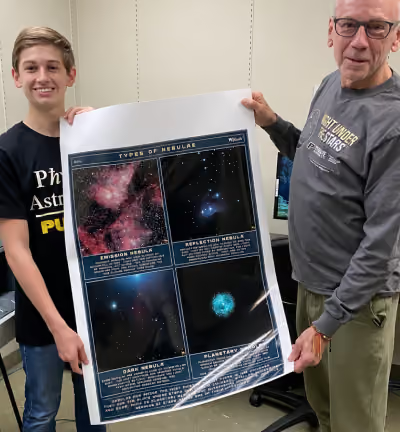
Slooh has had the privilege of connecting and working with numerous Purdue professors who are passionate about giving their students this new outlet to explore space and make their Astronomy curriculums as autonomous and experiential for students as possible.

Slooh Pro

One Price. No Proposals. No Travel.

Five Advanced Missions at a time across three continents — spectroscopy, photometry, and astrometry — for less than an hour of time at most observatories.

Pro

$499
/year
Buy Now

Custom

Request a quote for your
entire department
Request a Quote
Cancel anytime. Your data, images, and observations stay yours forever — even if you downgrade, your work is never deleted.