
Spooky Skies, Saturn’s Peak, & Slooh’s “Journey to Jasper"

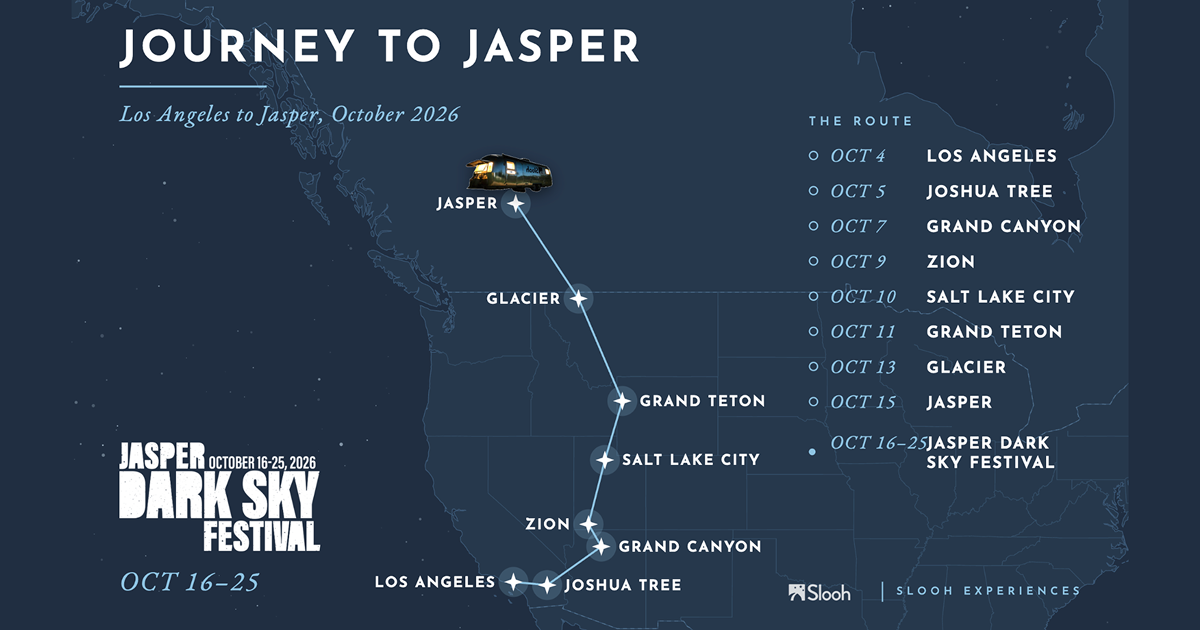
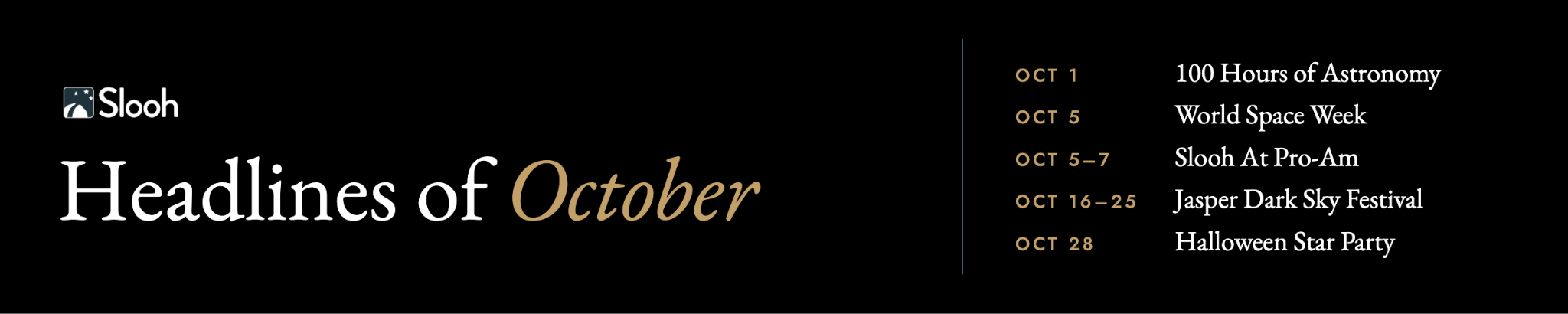
This month, Slooh hits the road for the Jasper Dark Sky Festival in the Canadian Rockies, heads to the IAU's International Pro-Am Workshop, kicks off 100 Hours of Astronomy and World Space Week with two LIVE Global Star Parties, and closes things out with a Halloween Star Party under a bright, just-past-full Moon. Meanwhile, Saturn reaches opposition on October 4, the Draconids and Orionids light up the sky, and our expanded solar hours are giving classrooms more time than ever with the Sun.
So step outside, let your imagination wander into the dark, and see what's waiting for you among the stars… it may be spookier than you think. Boo! 👻
Slooh Heads to the Jasper Dark Sky Festival
This October, Slooh is hitching up the Airstream and heading to the Canadian Rockies! The Jasper Dark Sky Festival returns October 16–25, bringing its annual celebration of stargazing, science, and live music to the world's largest accessible Dark Sky Preserve, and Slooh will be part of the fun throughout the festival.
“Step inside the Slooh Airstream, our travelling astronomy hub, and explore the universe through interactive experiences, remote telescope demonstrations, and conversations about astronomy and dark skies. Discover how remote telescopes around the world let you observe the cosmos in real time, bringing the wonders of the night sky closer than ever. Open daily throughout the festival, the Airstream welcomes visitors of all ages to explore, learn, and connect with the night sky.”
If you're in Jasper, come say hello! If you're not, follow along with us online as we explore some of the darkest skies on the planet.
Follow the "Journey to Jasper" on Slooh's socials → https://www.instagram.com/Slooh/
100 Hours of Astronomy: The Sky Never Closes
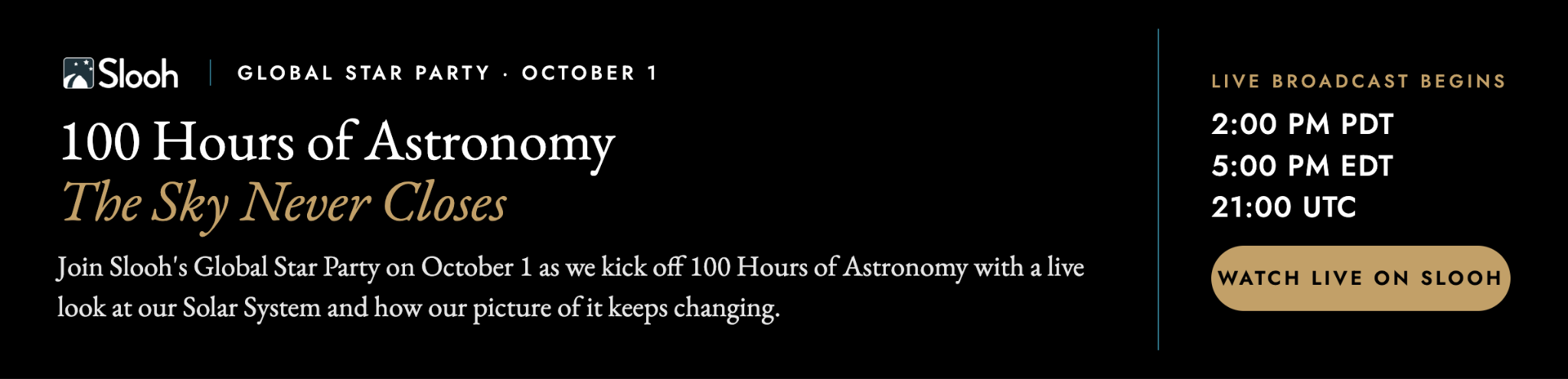
100 Hours of Astronomy is an annual worldwide celebration organized by the International Astronomical Union's Office for Astronomy Outreach: a round-the-clock, round-the-globe stretch of public stargazing, talks, and shared skywatching. This year's theme turns our attention to the Solar System, and to the idea that science isn't a fixed set of answers but an ongoing process of looking, questioning, and revising.
Round-the-clock astronomy is exactly what Slooh does. With telescopes around the world, the sky is always open somewhere: live views of the Sun by day, the Moon and planets by night, and missions you can schedule at any hour, from anywhere.
The broadcast streams free on Slooh's social channels. Slooh members can join the live Zoom webinar to interact with the show and ask questions in real time.
→ https://app.slooh.com/shows/video-viewer/1262
World Space Week: Space for Everyone
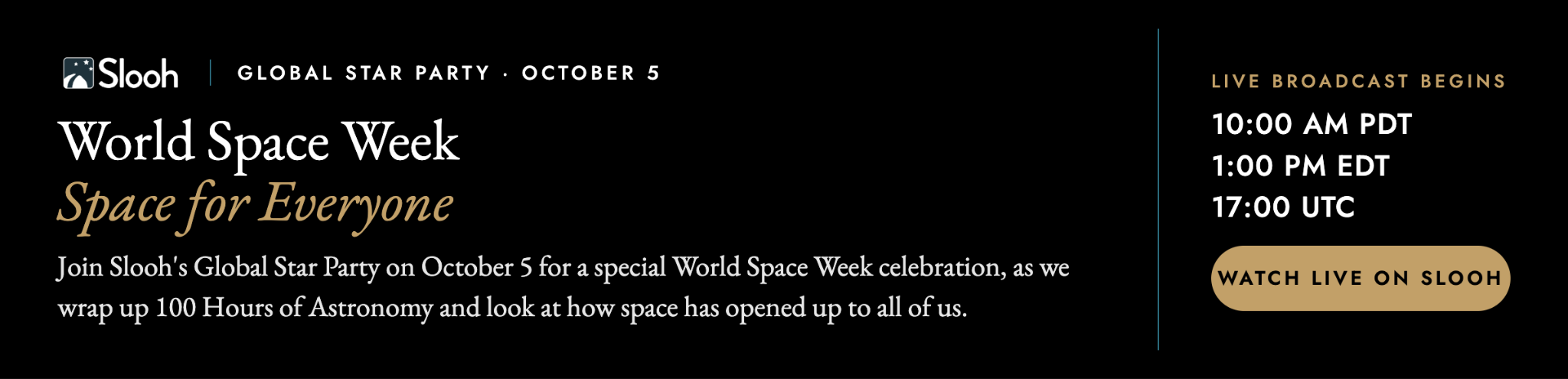
Join Slooh's Global Star Party on October 5 for a special World Space Week celebration, as we wrap up 100 Hours of Astronomy and look at how space has opened up to all of us.
Live broadcast begins:
🕓 10:00 AM PDT | 1:00 PM EDT | 17:00 UTC
World Space Week begins each year on the anniversary of Sputnik 1, the first satellite to orbit Earth, and runs for a week of space events in classrooms, planetariums, observatories, and backyards worldwide. It's a global reminder that space isn't just for astronauts and agencies. It belongs to everyone who looks up.
When Sputnik launched, only a handful of nations could reach space. Today, rockets fly more often, from more places, built by more people than ever before. The sky has been opening up, one launch at a time.
Slooh was built on the same idea: that anyone, anywhere, should be able to explore the Universe through a real telescope. Day or night, Slooh's telescopes put space within reach, whether that's a live look at the Sun, the Moon, or a mission you schedule yourself.
The broadcast streams free on Slooh's social channels. Slooh members can join the live Zoom webinar to interact with the show and ask questions in real time. → https://app.slooh.com/shows/video-viewer/1263
Slooh at Pro-Am in Pennsylvania
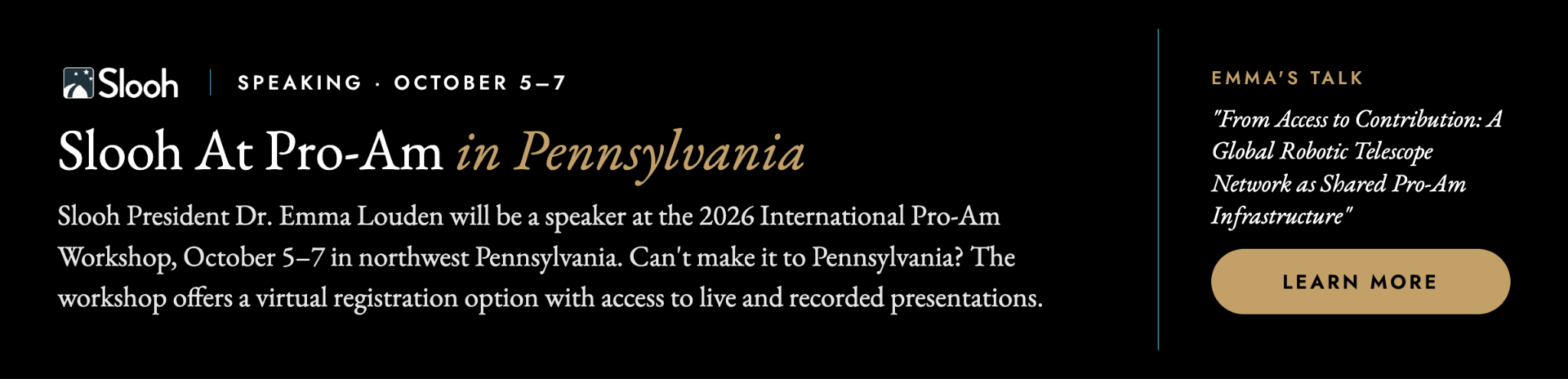
Amateur astronomers have been making real contributions to science for centuries, and this October, Slooh is joining the conversation about what comes next. Slooh President Dr. Emma Louden will be a speaker at the 2026 International Pro-Am Workshop, October 5–7 in northwest Pennsylvania. A joint initiative of the International Astronomical Union's Professional-Amateur Relations in Astronomy Working Group and the Oil Region Astronomical Society, the workshop brings together professional astronomers, amateurs, educators, and students to build new research collaborations. Emma's talk, "From Access to Contribution: A Global Robotic Telescope Network as Shared Pro-Am Infrastructure," explores how networks like Slooh's can do more than open the sky to everyone: they can turn that access into real scientific contribution. Can't make it to Pennsylvania? The workshop offers a virtual registration option with access to live and recorded presentations.
Learn more about the workshop → https://oras.org/iau-2026-pro-am-workshop/
Halloween Star Party
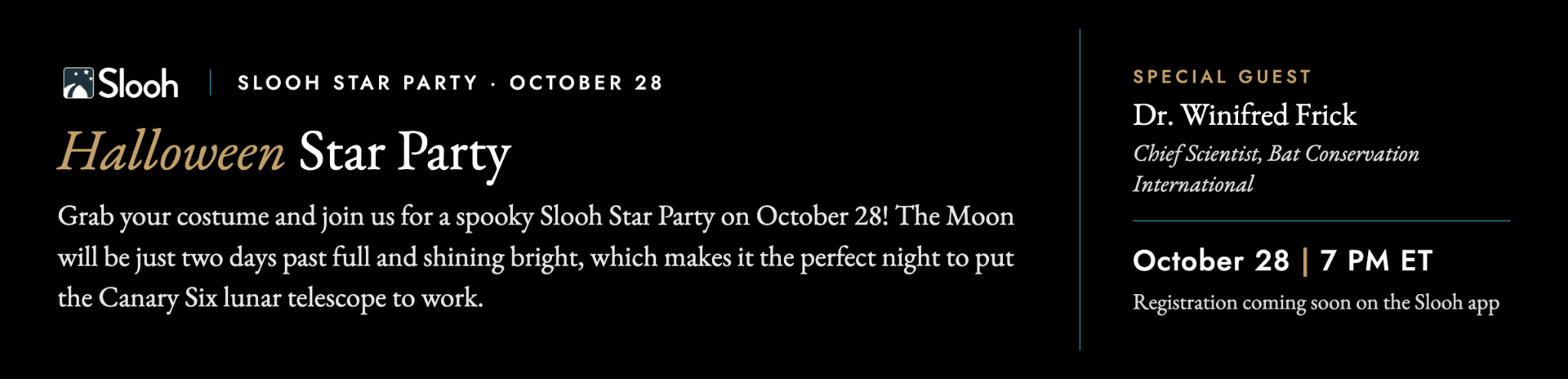
Grab your costume and join us for a spooky Slooh Star Party on October 28! We're thrilled to welcome back Dr. Winifred Frick, Chief Scientist at Bat Conservation International, whose research helps guide conservation decisions that protect bat species and their habitats around the world. She'll be joining us to share what these fascinating night flyers are up to under the autumn sky. The Moon will be just two days past full and shining bright, which makes it the perfect night to put the Canary Six lunar telescope to work. Star Party will be live to register soon on the Slooh app.
Week 1 · Higher Ed & the Cosmos (Sept 28–Oct 4)
Oct 1–4 | 100 Hours of Astronomy
The IAU's round-the-clock worldwide observing marathon is here. It's a natural moment for campuses and classrooms everywhere to look up together. Read about our star party above!
Oct 3 | Last Quarter Moon
The Moon reaches the Last Quarter on October 3. It will rise around midnight, leaving the early evening sky relatively dark for observing.
Oct 4 | Saturn at Opposition
Saturn reaches opposition on October 4, making this one of the best times of the year to observe the ringed planet. It will be bright and visible throughout the night, with its rings tilted about 7.5° toward us. Saturn will appear in the constellation Cetus, near the border with Pisces.
Week 2 · One Sky, One World (Oct 5–11)
Oct 6 | The Moon Meets Jupiter
The waning crescent Moon passes close to Jupiter before dawn. From parts of North America, the Moon will even pass in front of Jupiter in a rare lunar occultation. It's a great opportunity for a classroom or group observing session.
Oct 8–9 | Draconid Meteor Shower
The Draconids are unusual because they're an evening meteor shower, with the best viewing around the evening of October 8 and into the early hours of October 9. Rates are generally modest, but this year's nearly new Moon means moonlight won't interfere with viewing.
Oct 10 | New Moon
The Moon reaches its New Moon phase on October 10, creating some of the darkest skies of the month. The nights around the New Moon are an excellent opportunity to look for galaxies, nebulae, and other faint deep-sky targets.
Week 3 · Journey to Jasper (Oct 12–18)
Oct 12 | Mercury at Greatest Eastern Elongation
Mercury reaches its greatest eastern elongation from the Sun on October 12. Look low in the western sky after sunset It's a great evening viewing opportunity for the Southern Hemisphere, though the planet will be challenging to spot from northern latitudes.
Oct 14 | Jasper Dark Sky Festival Opens
Ten days of stargazing in the Canadian Rockies begin, and Slooh is there! Stop by the Slooh Airstream or join a Hands-On Observation Workshop. Learn more above.
Oct 18 | First Quarter Moon
The Moon reaches the First Quarter on October 18. Sunlight rakes across the lunar terminator, throwing craters and mountains into sharp relief. It's a great time to observe the Moon with the Canary Six.
Week 4 · Under Jasper's Dark Skies (Oct 19–25)
Oct 21–22 | Orionid Meteor Shower
The Orionids are created by debris from Halley's Comet, with meteors entering Earth's atmosphere at about 66 km/s. The shower peaks around October 21–22. Moonlight will interfere with some viewing this year, but the Moon sets before dawn, creating a darker window for early-morning observers.
Oct 25 | Jasper Dark Sky Festival Closes
The Jasper Dark Sky Festival wraps up its final weekend under the stars.
Week 5 · Spooky Skies (Oct 26–Nov 1)
Oct 26 | Full Hunter's Moon
October's full Moon is known as the Hunter's Moon, following September's Harvest Moon. Look for the bright full Moon on the night of October 25–26.
Oct 28 | Halloween Star Party
Join us live for a spooky night of the Moon, Saturn, and creepy cosmic objects. Learn more above.
Nov 1 | Clocks Fall Back
Daylight Saving Time ends in the U.S. on November 1. Clocks move back one hour, meaning darkness arrives earlier in the evening and gives classrooms and families more time for observing before bedtime.
🎃October Quest Guide🌌🔭
October skies are full of celestial treats, and Slooh has Quests ready to make the most of them! Here's a taste of what Members can explore this month:
🏹 Under the Hunter's Moon: October’s full moon takes center stage in the Hunter’s Moon 2026 Quest, where Members discover the traditions behind this seasonal lunar name and capture the full moon themselves on October 25, 2026. It’s a perfect opportunity to connect a celestial event visible around the world with the stories and traditions inspired by the changing seasons.
🚀 The Ultimate Solar System Expedition: In the Capture the Solar System Quest, Members set out on an ambitious journey to photograph the worlds and smaller bodies of our cosmic neighborhood. Using Slooh’s telescopes around the world, they’ll work toward capturing the Sun, Moon, all eight planets, five dwarf planets, asteroids, near-Earth objects, and even a comet. Along the way, Members learn to plan their own observations while discovering how each object helps tell the story of our Solar System’s 4.6-billion-year history.
A Cosmic Twin Awaits: The Milky Way Doppelganger Quest takes Members deep into space to discover a galaxy that mirrors our own. Along the way, they’ll learn the fundamentals of galaxies and uncover the truth that the Milky Way is far from alone in the Universe – and it even has a twin!
Forces That Rule the Cosmos: The Universal Gravitation Quest challenges Members to explore the laws that govern celestial motion. With a strong math focus and a creative poster project, this Quest blends critical thinking with cosmic exploration.
Rediscovering Pluto: In the Clyde Tombaugh Quest, students follow in the footsteps of Pluto’s discoverer. Using Slooh’s animation tool, they’ll blink-compare captures of Pluto to make their own “discovery” of Pluto – just as Clyde Tombaugh did nearly a century ago.
Share Your Discoveries: Encourage Members to share the images they capture with our telescopes! The Gravity Awards Quest teaches how to post Observations and engage with the Slooh community.
This month, our spotlight shines on the Sun, and on the students capturing it!
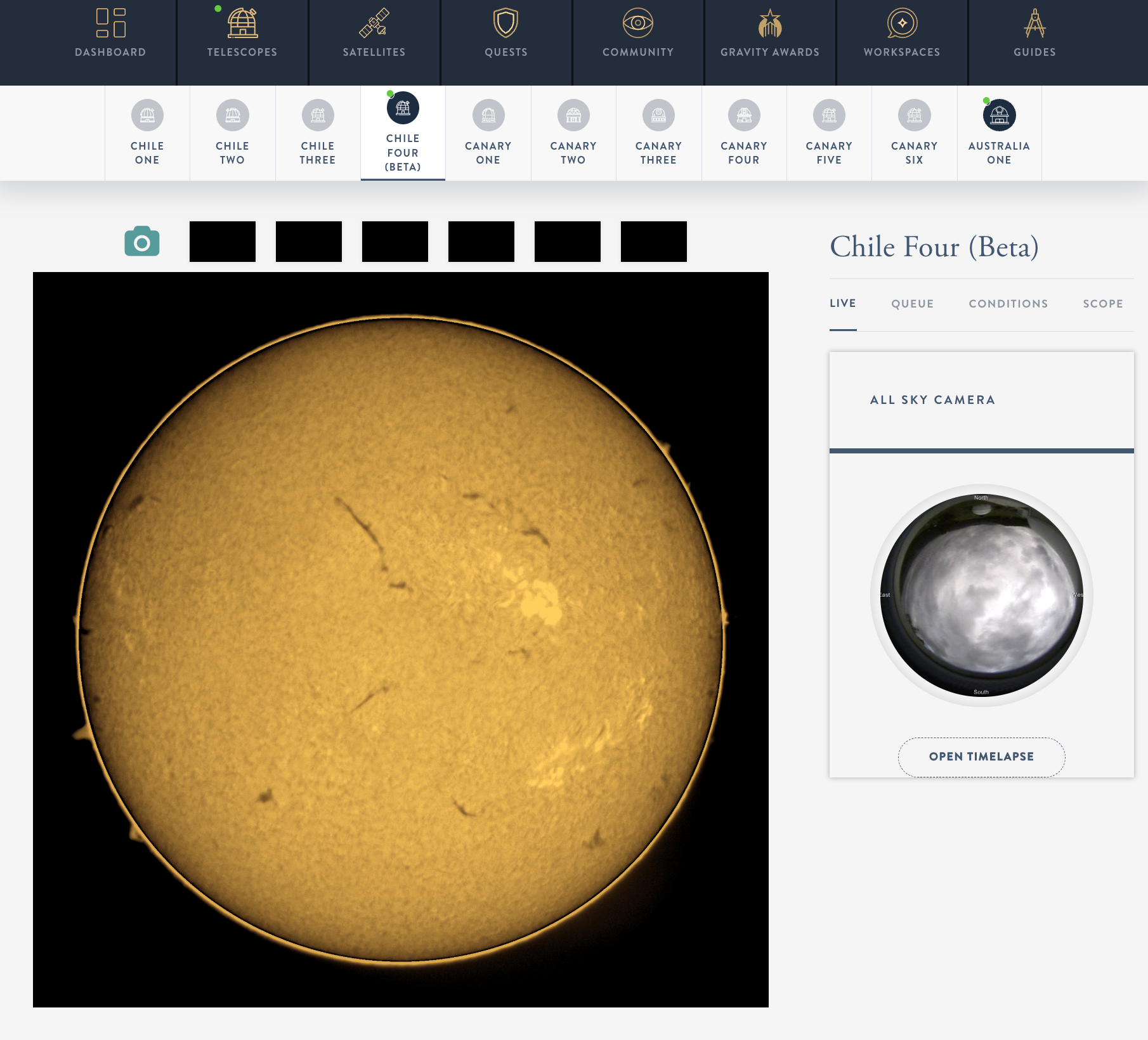
As October days grow shorter and the nights get spookier, Slooh is giving you more time with our nearest star. We've expanded solar observing hours with longer observing windows on Canary Five and added a new solar scope, Chile Four (beta)! (Down in the Southern Hemisphere, Chile's days are only getting longer.)
The effect in classrooms has been immediate. Students now have far more chances to get the solar images they need, on their own schedules. No ghosting from the Sun here.
At Cuesta College in San Luis Obispo, CA, Professor Patrick Len's students are capturing the Sun for the Solar System Explorer Quest with far less waiting…
"Things are going really well. My students are having a much easier time getting their Sun photos for Solar System Explorer, thanks to Canary Five's longer hours, the Chile Four beta, and having Canary Six as a dedicated lunar scope."
— Patrick Len, Cuesta College
At Utah Tech University in St. George, UT, Professor Dave Syndergaard has seen the difference too. He's also a fan of our new Slooh Tutorial Quest.
"The Chile solar telescope has really helped. And the new Tutorial Quest gets my students into the rhythm of Quests much better than Slooh Explorer did." —Dave Syndergaard, Utah Tech University
A huge thank you to Professor Len, Professor Syndergaard, and their students for putting our new solar hours to work!
No tricks, just treats: go capture the Sun for yourself → https://app.slooh.com/object-details/3/overview
Our featured object this month is the ringed wonder of the Solar System: Saturn!
The second largest planet in the solar system, more than 60 moons are known to orbit this ringed gas-giant. Among them, Titan's liquid methane lakes exhibit tides; and Enceladus has a subsurface ocean that may harbor life. Read Slooh’s Saturn Guide→ https://app.slooh.com/object-details/3/overview
On October 4, Saturn reaches opposition, shining at magnitude 0.3 and 19.7 arcseconds across, visible all night long. There's no better time all year to capture it. Schedule your own Slooh mission here!
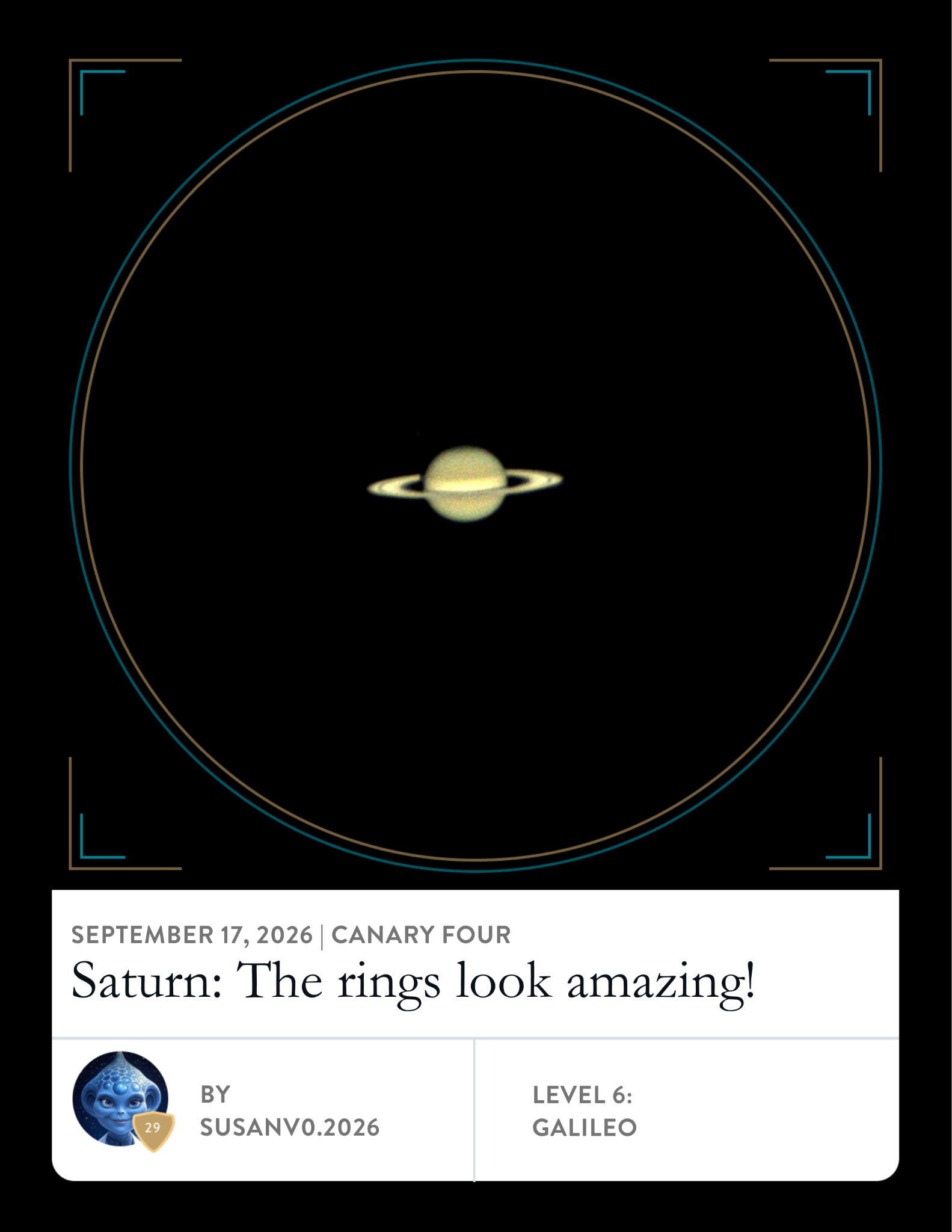
There's no end to Slooh's ring joy! 🪐